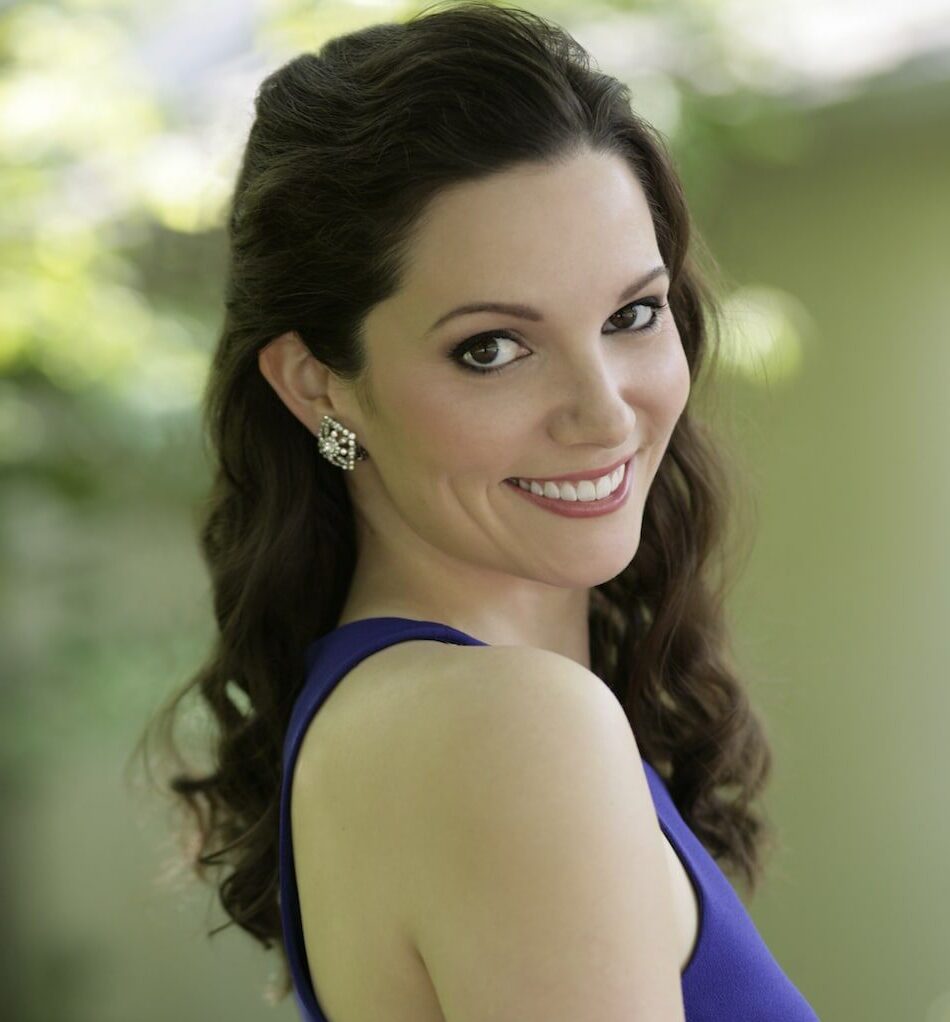
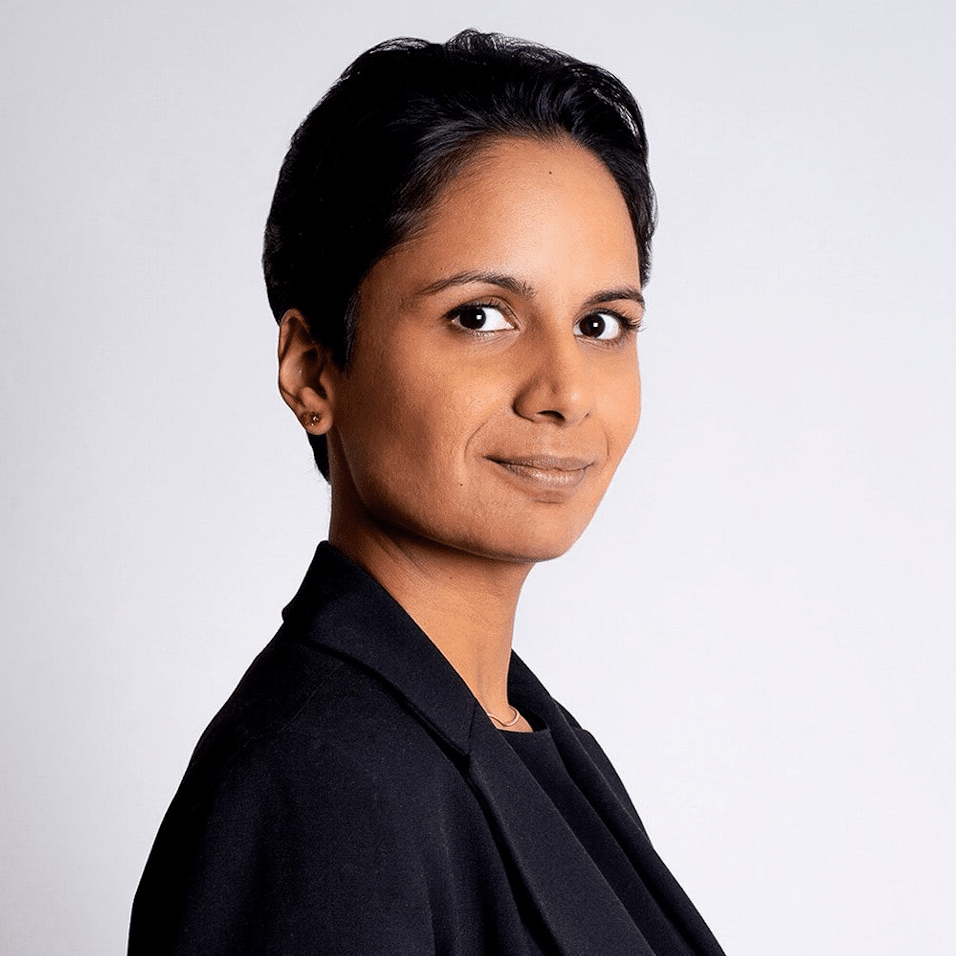
Pianist Morgan-Paige Melbourne shares insights on her relationship with the piano, how she approaches composing and what’s she’s been doing during the pandemic. She’s currently working on Where Do I Go?, a new short film intertwining piano, contemporary dance and spoken word.
What do you love about the piano?
The piano has always been another voice for me. Even from a really young age I was just drawn to it; we had a piano that was given to us by one of our church members. Whenever I feel like I can’t say what is on my mind, playing the piano just feels right; it’s how I express myself!
Where do you search for inspiration when approaching a new composition?
There’s always some soul searching involved in composing! I find inspiration from what I’m experiencing emotionally, or what’s around me. I’m really passionate about social justice issues and that’s something I like to draw from.
I also love listening to rock and heavy metal because of the way they implement their minor and tonal structures. It’s so beautiful! I love the lyricism of neo-soul and R&B – I try my best to add a little bit of what I love, but also still make it something that’s my own.
What excites you about collaborating with dance artists on this project?
A dancer doesn’t think in the way a musician does, and a musician doesn’t think in the way a dancer does. How we approach music or symbolism is so different!
We’re asking questions like how are we going to play off the themes? How are we going to bounce off each other’s emotions? What can we see, what can we hear? It’s very sensory, and it really amplifies the fact that you can experience music in so many different ways and in so many visual representations.
What artists are you listening to at the moment?
Recently I’ve been listening to neo-soul artists like Jordan Rakei. He infuses 70s funk and soulful gospel, but it’s still secular music. The harmonic structure of it is absolutely divine, I love the way he plays around with vocal harmonies on top of music.
I grew up listening to bands like Red and Skillet – a lot of it is very symphonic. I like the connection between classical and rock music, the structures and formats are similar with vocalizations on top.
Have you been doing much performing online?
Absolutely! The pandemic has given me more time to work on things that I haven’t been able to do in so long. I’m actually really grateful for the time to focus on different projects.
I’ve released an EP as well as an album and I’ve worked a lot with my sibling too, we’ve been producing videos. I’ve also spent time just experimenting with different things, even doing digital collaborations with musicians overseas, expanding the network!
It’s actually been amazing to see the innovation that’s come out of all of this.
Morgan-Paige Melbourne stars in Where Do I Go?, a stunning short film intertwining piano and dance, premiering March 27.
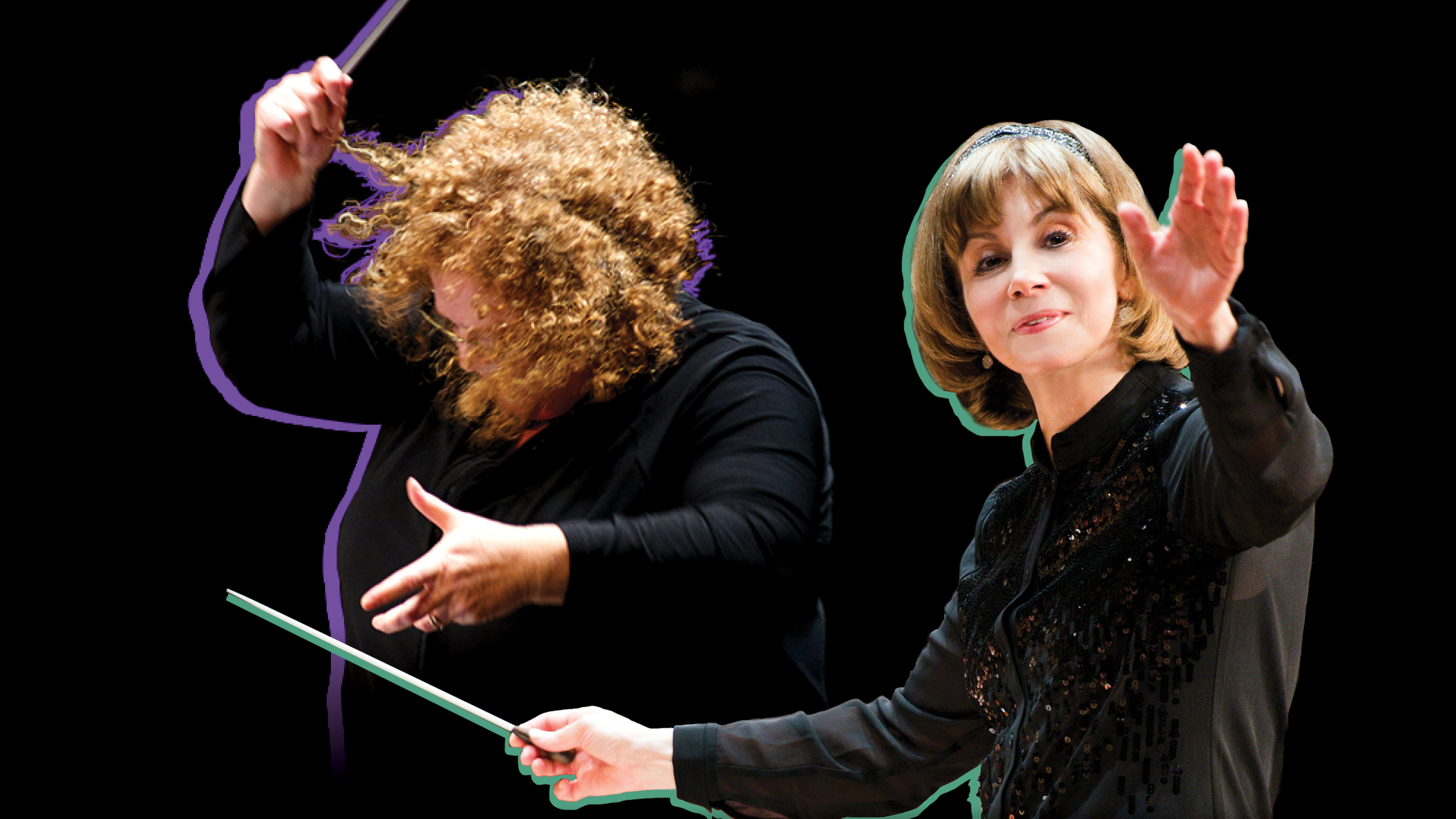
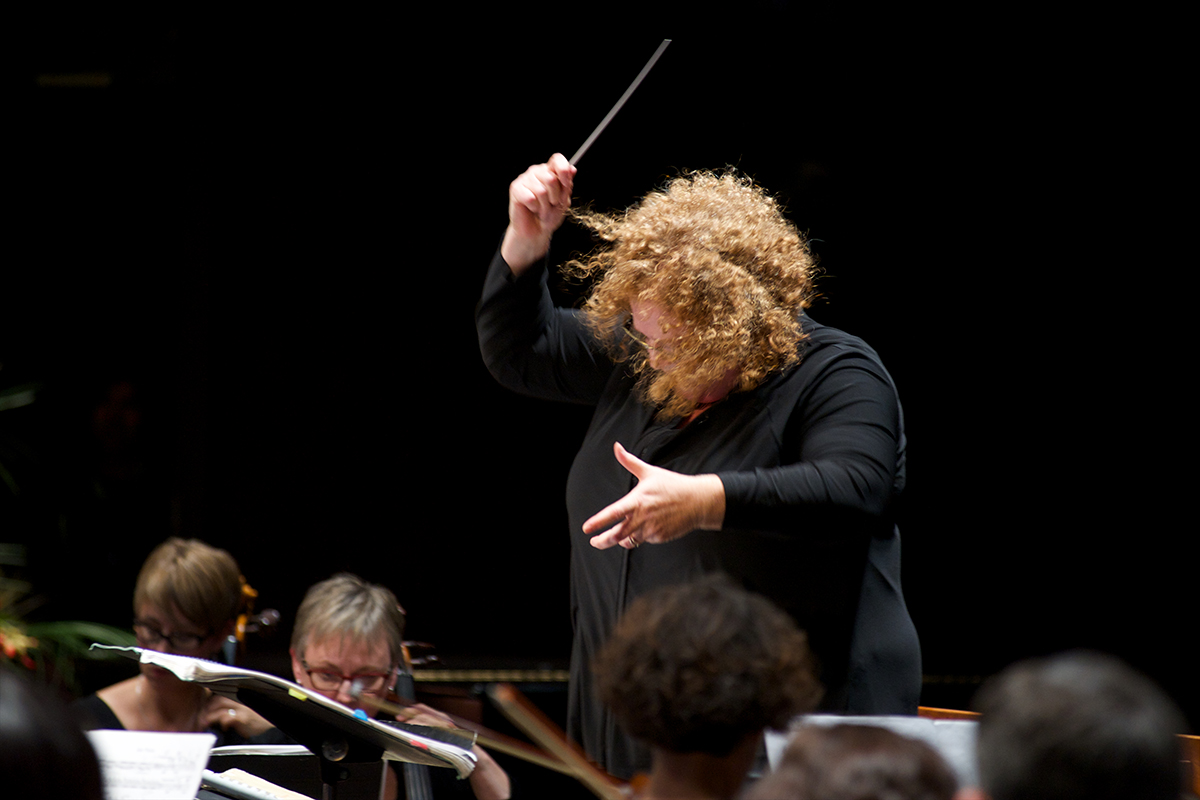
Now the conductors are taking on a new project as Career Mentors, vital roles in Tapestry Opera’s innovative conducting program Women in Musical Leadership. The pair recount their journeys onto the podium and reflect on the role mentorship played in their careers.
How did you train?
JF: I started my musical training on classical guitar but also studied music theory and ear training in addition to piano as a child and teenager. For my undergraduate studies I entered the Mannes School of Music as a guitar major and transitioned to a dual guitar and conducting major in my second year. I selected Juilliard for my Masters and Doctorate because of its excellent conducting program led by Maestro Jorge Mester. I also had the privilege to study for many years with Maestro Sixten Ehrling.
RT: I had two mentors that gave me the idea that I could conduct, Ann Cooper Gay and her husband, Errol Gay. Ann brought me in to work with the High Park Girls Choir, and at that point I really fell in love with the feeling of the sound coming back to me.
I applied to the special programme in Conducting at the University of Toronto, I had graduated there with my undergrad in piano. I remember sitting late at night and looking at the sign on the bulletin board thinking: I wonder if they would take a woman in the conducting programme? I applied – I didn’t get in the first year, but I did the second.
The rest of my training was much less formal, and much more practical. I spent three summers as the Assistant Conductor, and eventually the Personnel Manager and Librarian, of the Boris Brott Summer Festival in Hamilton Ontario; I conducted four community orchestras at one time; I did workshops; and I put together my own charity shows with friends at the University of Toronto.
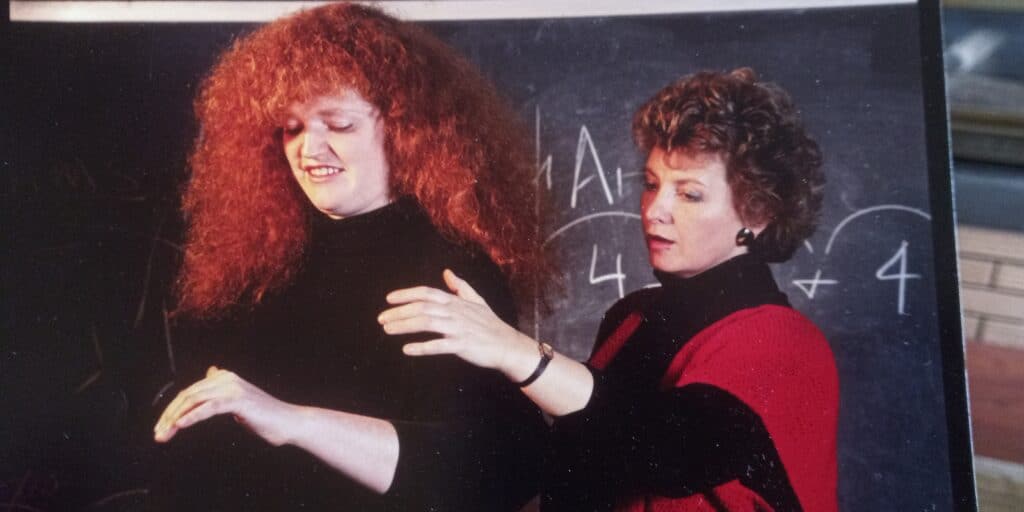
Rosemary Thomson as an undergraduate during her first conducting class at the University of Toronto, with professor Doreen Rao
What opportunities existed for you?
JF: My first professional conducting position was with the Denver Chamber Orchestra followed by positions with the Milwaukee Symphony, the Bay Area Women’s Philharmonic, the Long Beach Symphony, the Virginia Symphony, the Ulster Orchestra, the Hawai’i Symphony and the Buffalo Philharmonic.
RT: You have to get in front of players. No textbook is going to take the place of that learning opportunity. At the start of my career I sought out any workshop that I could, because I knew I wasn’t at a place where I was going to be offered professional conducting opportunities. I went after lots of opportunities that I didn’t get, but you have to just keep going after them.
I did the Contemporary Opera programme at the Banff Centre, a time which really changed my life. I met James Rolfe, the Artistic Director of Continuum Contemporary Music at the time. He saw me conduct something in a showcase in Banff, and hired me on the spot to conduct a concert with Continuum back in Toronto. It was my first professional hired gig, and I went on to conduct with that group for 14 years.
It was a time that I thought wow, someone’s paying me to do this thing that I love! From there I won auditions to learn on the job in professional conducting residencies with Bramwell Tovey at the Winnipeg Symphony, Hans Graf at the Calgary Philharmonic and to assist Richard Bradshaw at the Canadian Opera Company. These residencies gave me the chance to put my 10,000 hours in on the podium, but also to learn first hand about being a music director from some giants in our profession.
What is your career highlight?
JF: There are so many events and concerts that were personal and memorable for me, but let me at least mention as highlights my Carnegie Hall concerts with the Virginia Symphony and Buffalo Philharmonic.
RT: My first Beethoven Nine is a definite standout. But actually, I hope my career highlight is still in front of me! I love the big, iconic works like Orff’s Carmina Burana and Verdi’s Requiem that combine the forces of chorus and orchestra. When I got to be the one that’s leading them it was euphoric.
I think because I also grew up singing, I love every opportunity to conduct opera. Being the Music Director for the world premiere of Yvette Nolan and Dean Burry’sShawnadithit for Tapestry Opera and Opera on the Avalon was one of the most deeply gratifying experiences of my career.
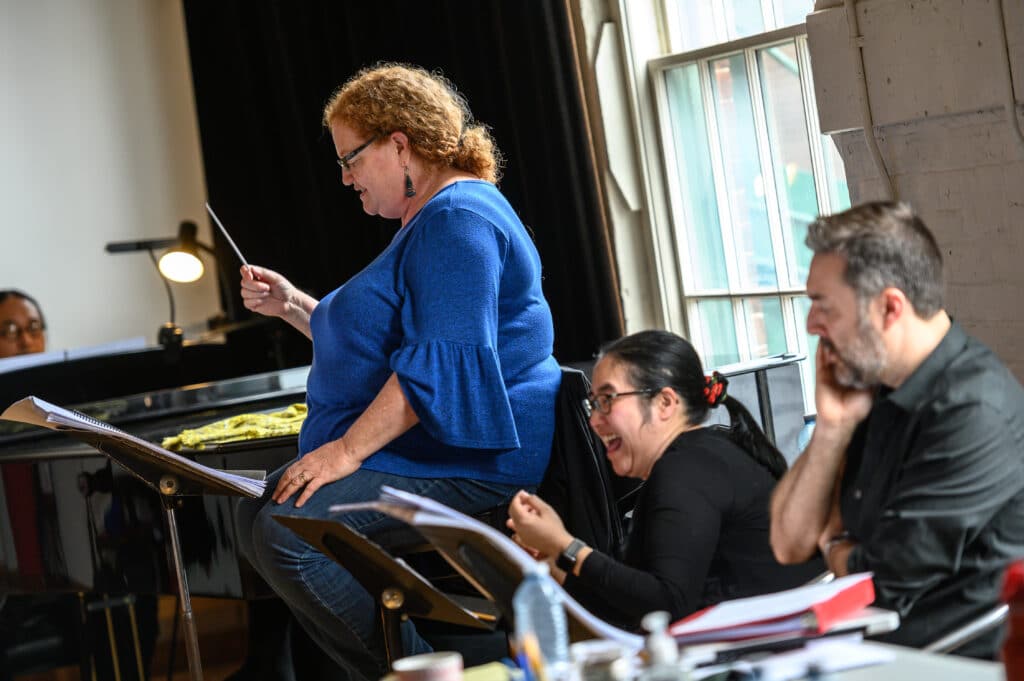
Rosemary Thomson rehearsing for Shawnadithit. Photo by Dahlia Katz.
What have you learned over the course of your career?
JF: For me the most important thing about conducting is being keenly aware that the orchestra itself is actually making the music, not the baton! I firmly believe that each performance comes from the collective hearts, brains and spirit of the musicians who are involved, and that because of that, each orchestra’s performance will be unique.
I like to be flexible in allowing the orchestra to play a major role in informing the performance, revealing their own strengths and personality. Does the orchestra’s hall enable them to play refined and varied dynamics? The conductor should allow that to happen! Do the woodwind players revel in their individuality of approaches? So should the conductor! Does the orchestra enjoy rhythmic flexibility and rubato? Does the string section have a unified approach to articulation and bow stroke? Does the brass section exemplify brilliance or warmth in their artistic approach?
To me it is a delight that each orchestra I conduct can sound quite unique in exactly the same repertoire – and what a shame it would be to try to make each orchestra sound exactly alike!
RT: There’s a transition that happens for everybody in leadership at some point in their lives, where you stop feeling like an imposter and you realise that you have the skills. I think that the most important thing that I learned (and I’m still learning it) is to trust that I can do things my way that fit me best.
I’ve been mentored a lot, but the key for me is to take from them what works for me, and to be authentic. That gets clearer and clearer as I have gained maturity and experience. I’m not trying to be somebody that I’m not, instead I’m really going after my authentic connection to the music, to the musicians that I get to perform with, and to our audience.
And that, to me is what’s going to make me the best musical leader that I can be.
What are your favourite kinds of pieces to conduct?
JF: I am fascinated by the seeming limitlessness of the orchestral repertoire. It is as if the body of work is a vast iceberg and we are only playing the tip of it!
I may not have a favorite piece but I may have a favorite period of music to conduct – the start of the 20th century was an extraordinary time where composers were branching out from romantic nationalism in so many unique ways harmonically, rhymically and structurally; all the while expanding the woodwind, brass and percussion sections creating a luminous orchestral palette.
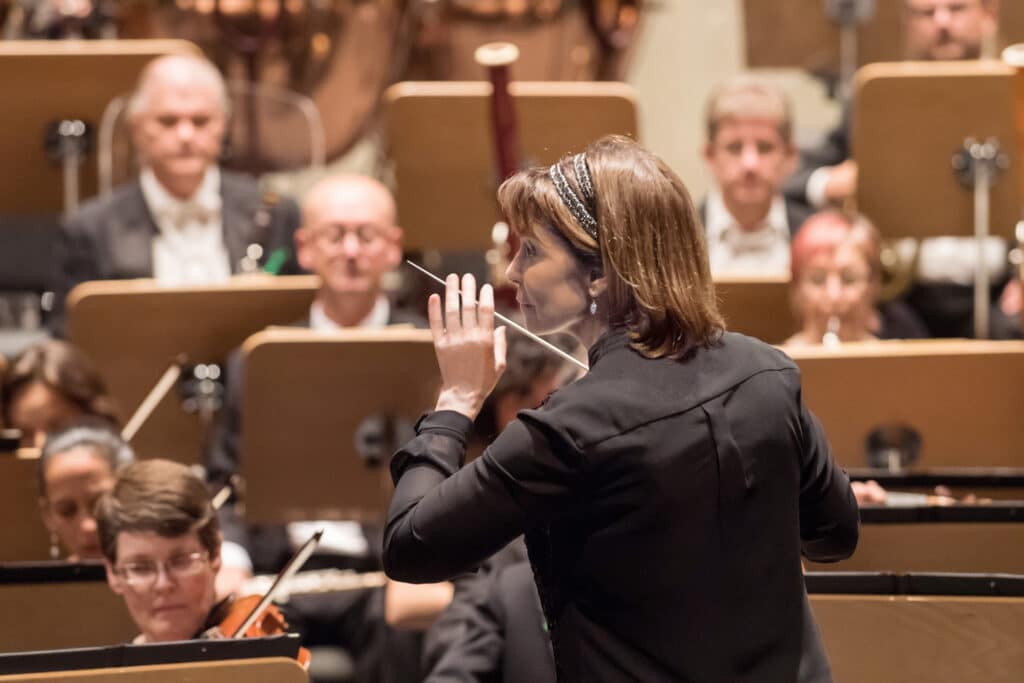
JoAnn Falletta. Photo by Guillermo Mendo
RT: That’s hard, it’s like asking who’s your favourite child!
I guess it’s whatever I’m conducting at the time. But having said that, I do have an affinity for certain composers. I love Britten, Ravel, Debussy. And there’s something about Beethoven’s rhythmic drive that I dig into with great relish. I love thinking about colour and texture in music and the combination of text and music, voice and orchestra, and dramatic, musical storytelling is why I love conducting opera.
If someone didn’t know anything about conducting, what would you want them to know?
The conductor is a catalyst for change […] radiating the reflected glow of the talented players around them.
JoAnn Falletta
JF: Conducting in a sense is the art of persuasion by which musicians come to share a deep connection to the music they are playing – and to convey that passion to the audience. The image of the conductor on the top of a pyramid is exactly the reverse of the real situation. The pyramid is inverted and the conductor supports and empowers every musician, creating a situation where they can feel both independent and protected.
The conductor is a catalyst for change, sparking thought, offering possibilities, and radiating the reflected glow of the talented players around them. The art of performance is deeply embedded in the spiritual, psychological and artistic tradition of transformation.
RT: What I’m striving for when I’m conducting is to move beyond the technical requirements of keeping people together and setting tempos. Instead, to facilitate and inspire the musicians to bring the music off the page and connect directly with the audience so that it’s much more than just an upbeat and a downbeat – it instead becomes a realisation of the composer’s vision through the unique personality and humanity of that group of musicians. If each musician feels supported and encouraged from the podium to play at the top of their game they will shine, and if they shine, so will Beethoven. Plus, it’s fun!
What role did mentorship play in your early career?
JF: For all young artists a mentoring relationship can be essential to their development. Instrumental in my development were my studies with Maestros Mester and Ehrling, and my studies at the Mannes College of Music. I was also privileged to have masterclasses with Leonard Bernstein at the Juilliard School.
RT: I needed others to believe that I had the potential for this before I could truly believe in myself. And I think it does have something to do with the fact that I didn’t see a lot of women on the podium, so I had doubt that it was a career that I would be allowed to pursue.
I felt so strongly that conducting was something I loved that I just kept putting myself out there – even though it was hard. My mentors never made me feel that because I was a woman I shouldn’t be a conductor. Ever, and for that, I am very grateful.
Some conductors have the confidence to get up there right from the get go. I had to grow into that confidence, to dig in and feel like I had earned the right to step on the podium. And that was what mentorship gave me above everything, the gift of believing in myself. Which is why it’s so important to me to become a mentor for others.
The next generation of conductors will be finally the one that stops saying ‘female conductor’ and just says ‘conductor’.
Rosemary Thomson
Why are you participating in the Women in Musical Leadership program?
JF: Women In Musical Leadership is a fantastic program that is supporting and preparing Canadian women for careers in opera and orchestral conducting.
RT: I’m a passionate teacher. My mom was a teacher and I think I got that from her. I love seeing potential in others and helping them see it in themselves. I think that that’s a really important role as a mentor.
I was assisting David Agler on Stravinsky’s The Rake’s Progress at the Banff Centre and I got to conduct a semi-staged understudy cast with the orchestra. On the night of my performance David was so nervous for me that he actually said to one of my friends that he would rather conduct the Ring Cycle from memory! It wasn’t that he didn’t think I could do it, he just cared so much about me succeeding. It was a huge moment for him as a mentor. I can appreciate that now that I’m mentoring younger conductors, because you want to give them the wings to fly and then get out of the way.
What is the potential of the Women in Musical Leadership program?
JF: The Women in Musical Leadership has the potential to be a key educational source in preparing women for a career in conducting.
RT: Infinite.
I think that the next generation of conductors will be finally the one that stops saying ‘female conductor’ and just says ‘conductor’.
We’re going to change the perception by providing opportunities for multiple women to see themselves in that role. And over time, the programme won’t be necessary anymore. Then we’ll know we’ve succeeded.
Find out more about the Women in Musical Leadership program and the inspiring team involved in the project.
Tapestry’s Artistic & General Director Michael Hidetoshi Mori shares a personal story about his grandmother’s experience as a French-speaker; inspired by the themes of identity raised in Our Song D’Hiver
C’est l’hiver! In exploring the French-Canadian for Our Song D’Hiver with opera singer Mireille Asselin, it reminded me of a conversation with my grandmother:
I followed Quebec’s movement to separate when I was younger, and it was easy for me to think of Canada as two majorities, French-speaking in Quebec and English-speaking everywhere else. I think I took the homogeneity of the majority cultures for granted, perhaps ironic as a kid of Japanese and mixed European background parents, or logical as someone whose musical education was driven by being a boy-soprano in a great Anglican music program.
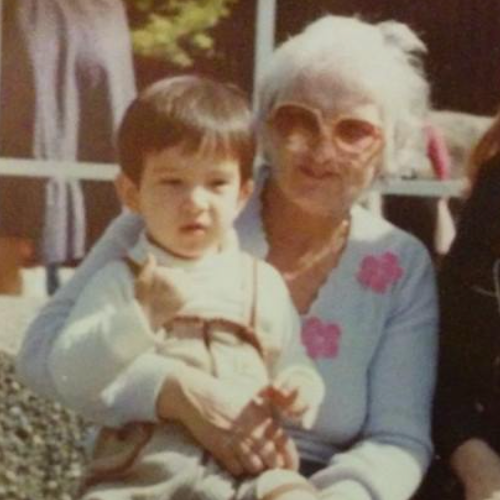
I didn’t know that my grandmother Gladys was born French-Canadian until I was a teen… a surprising discovery as she wasn’t a French-speaker, disappointing my short-lived hope that she could help with French homework!
When I asked her why she didn’t speak French, her answer was simple
Her story turned out to be fascinating, and in retrospect, perhaps indicative of isolated francophones in the prairies in the 1920’s in majority english-speaking towns. Born as the 9th daughter (no sons!) to a farming family, she was already having to fight for her place in the world. When I asked her why she didn’t speak French, her answer was simple, when she turned school-age, she went to school and was regularly made fun of for her accent and use of french words. She hated that feeling and decided then and there to learn English and eliminate any opportunity to be bullied again. Eventually she would switch to answering in English at home with her family when spoken to in French. When as a teenager, she eloped with her protestant english-speaking neighbour and her French-Catholic family refused to speak to her or even look at her in the eyes, she saw no more reason to maintain the French-speaking aspect of herself and by the time she was in her twenties living in Vancouver, she had completely lost the practice and eventually ability to speak her mother tongue.
It’s funny reflecting on how much changes in two generations
It’s funny reflecting on how much changes in two generations. Most parents I know are considering putting their kids into immersion or cultivating another language if it is part of their background. No doubt Toronto in 2021 is vastly different to 1920’s Bigger, Saskatchewan, but I still found this story so tragic. I really love the complexity that comprises each of us and believe that the fear-driven ideas of a homogenous Us and Them in any community, are dangerous falsehoods that hold us collectively back.
Our Song D’Hiver with Mireille and Frédéric and friends is a special opportunity to celebrate artists who have complex connections to their French-speaking sides, whether they are Francophones outside of Quebec, those living in bilingual communities, or relative newcomers in Francophone places.
Above all, Mireille and I found joy in the idea of modelling this a little bit after a house soirée or kitchen concert, celebrating the maritime way that friends and strangers come together to share cheer, music, and stories in the coldest months.
“I realized that what was interesting to me was the messy middle of being in between two cultures” – Mireille Asselin
A singer deemed “superb” by the Los Angeles Times, and praised by Opera Canada for her “vivacious stage presence” and as a “soprano that charms and brightens a room”, Mireille Asselin has performed all over the world including five seasons at the Metropolitan Opera.
Mireille is now bringing it home for an intimate concert, sharing her warm personality, extraordinary talent and other exciting work she loves by French Canadian creators.
Tell us about Our Song D’Hiver. What can we expect from the performance?
This program was born out of a discussion with Tapestry’s intrepid leader, Michael Mori, about French-Canadian identity and how we could bring something that would showcase this important aspect of Canadian heritage to the stage. That led me to think about my own relationship to my French roots and upbringing. I’m in fact half Francophone and half American, and I grew up entirely in French minority communities outside of Québec.
Consequently, I’ve never felt I really fit in with any one community… never felt “French enough”. Belonging to, or coming from a few different cultures is a more and more common experience as our world becomes more multicultural, and I realized that what was interesting to me was the messy middle of being in between two cultures. Our Song D’Hiver will be part storytelling, part recital, part show-and-tell, but all celebration of bilingualism and of Francophone creators who also live in the in-between.
You’ve had such a diverse career spanning concert, opera and recital work. How has your experience impacted your approach to creating Our Song D’Hiver?
For many years, the relationship between English and French Canada has been described as the Two Solitudes / Les Deux Solitudes. In a lot of ways, this solitude and isolation still very much exists. The two music scenes are separate, the performers don’t really cross-pollinate even though we are so geographically close, and consequently tons of the great art that is being made by French-Canadians doesn’t make its way to Toronto stages. My experience with that gulf definitely influenced the curation of this program.
OurSong D’Hiver celebrates great music being created in Canada right now. Which artists are you working with, and what do you love most about their work?
The person I’m the most excited to be working with is my pianist Frédéric Lacroix. Fred was my first ever vocal coach when I was in high school and is one of the very best pianists and collaborators around. Seriously, he’s Canada’s best kept secret as far as I’m concerned. He’s also a brilliant composer and I’m so excited to premiere on this program a short song cycle he wrote back in 2003 called “Wednesday Night Haikus”. Fred set eight haikus to music, one for each of his Wednesday night coaching students, as a graduation gift to all of us.
For those who keep track of the opera scene, you’ll surely recognize a few names in the dedications – Meghan Lindsay, Sharleen Joynt, and myself, among others! I’ve been wanting to find an opportunity to perform this cycle for years and I’m so excited to be able to share it with Tapestry audiences. I’m also very excited to feature some great artists such as fantastic Acadian guitarist, Maxim Cormier (I saw him play in the Red Shoe Tavern in Cape Breton years back and he made such an impression I tracked him down), Élise Gauthier who created a beautiful poetic-cinematic exploration of identity I can’t wait to share, and compositions by up-and-comer Félix-Antoine Coutu, acclaimed Métis composer Ian Cusson, the brilliant Franco-Ontarienne Marie-Claire Saindon and many more.
What’s exciting about making art for online platforms, and how does this differ from your usual artistic process and practice?
Creating for an online film medium is a brand new frontier for me, and one that most of us in the music world have had to dive into head-first over this past year. We’ve tried to essentially keep to the traditional recital format with this concert while taking advantage of the digital tools at our disposal, such as being able to weave in separate video content.
Since it will all be experienced on a screen, it allows for some play with how different visual elements can be integrated, like how audience members can take in translations or show notes, how to cut and transition between pieces, and how to integrate story telling, all without jolting the viewer out of the concert experience.
Our Song D’Hiver premieres on Tapestry Opera’s YouTube channel on March 6, 8pm.
Location: Toronto, ON Type: Combination of part- and full-time, contract Reports to: Executive Director Salary range: $40,000/year full time (part time will be pro-rated)
Tapestry Opera is seeking a Project Manager for Women in Musical Leadership and Canadian Opera Resource
The role will be part-time until June 30th, 2021, full-time from July 1 2021 to June 30 2022, and reduced to part-time in July 2023. There is room for growth, negotiation, and retention into larger and longer term roles within the organization for the right candidate.
Women in Musical Leadership is a national, partnership-based, multi-year fellowship program for emerging female-identified and non-binary conductors. Women in Musical Leadership is a program designed to offer opportunities to top Canadian talent and address the longstanding gender imbalance in music direction and conducting in opera and classical music. It’s an advanced three-year fellowship program for 6 music directors/conductors in cohorts of 2, beginning a year apart. With the support of like-minded organizations across Canada, the goal of Women in Musical Leadership is to provide multi-faceted practical conducting training, mentorship, and professional opportunities to promising conducting talent, allowing them to focus solely on conducting for three years. The Women in Musical Leadership program is supported by the Azrieli Foundation.
Canadian Opera Resource is a membership-based, user-driven database and rights management platform for Canadian Opera, directly benefiting Canadian composers, librettists, Canadian opera companies and other opera professionals. It is a living site, a promotional platform, and an online marketplace for works and recordings of works of Canadian opera – it’s a catalyst for the creation of a Canadian opera canon and a one-stop resource for anyone interested in Canadian operas. This project will enter its final year of development in July 2021 and will need to be stewarded through its final year.
We are committed to equity and justice in hiring and will prioritize applications from people from communities of colour, LGBTQ2S, Indigenous, disabled, and other equity-seeking communities to apply
Things that matter:
We make art that is socially engaged – you have an understanding or lived experience of principles of equity and anti-oppression, and/or are interested in and open to the process of learning
You have an understanding of and connection to opera as an art form
You have solid writing, analysing, and communication skills
You have proficiency with Google Suite, Microsoft Office, WordPress, and basic design skills (familiarity with one or more of the following preferred: InDesign, Publisher, Photoshop, Illustrator, etc.).
You see challenge as an opportunity
You are looking for work you’ll love. We do this because we love the work, and we like each other.
What we Offer:
Comprehensive health benefits
Flexibility with hours, work-from-home days (even in non-pandemic times!)
Casual working environment
Unlimited vacation and paid time off
Open, transparent, and communicative office culture
Professional development opportunities
Office located in a bright, beautiful heritage building in the Distillery Historic District.
Your expertise is valued and trusted, and you will have real input into decision-making
Tickets to all Tapestry productions.
What you will do:
This is a comprehensive but not exhaustive list, in which there is room for growth as the program takes shape.
Women in Musical Leadership (WML) runs for 5 years, and Canadian Opera Resource (COR) will enter its final year of development and require shepherding through the completion of the project. Both programs are partnership-based, and require solid communication skills, provide good networking opportunities, and would be a good fit for someone looking to build relationships in the arts and opera sectors.
Organizational Participation
Participate in and contribute to strategy sessions and long term planning
Develop relationships with staff, volunteers, and board members
Identify areas for Professional Development within and outside the organization
Contribute to board meetings and AGMs as required
Communications
Act as Internal Communications director for WML and COR
be first point of contact for Participants
liaise between Participants and Conducting Advisory Circle as needed
Disseminate information about placements, travel, schedules, and important information to Participants
Ensure that clear, proactive, and open communication channels are nurtured and supported between all Participants, Mentors, Conducting Advisory, Partner Organizations, and Program staff
Scheduling and Travel
Manage placement schedule for all participants
Liaise with relevant staff at Partner Organization to clarify timelines, travel dates, and other relevant information
Book all travel and accommodation arrangements for placements
Maintain, update, and communicate about placement calendars
ensure all upcoming confirmed or potential placements are listed
ensure clarity of communication of schedule with Participants
Relationship Building and Partnership Management
Communicate regularly with Partner Organizations
With the support and guidance of the Executive Director, research and outreach to organizations who may be interested in becoming Partner Organizations
Maintain responsive, open lines of communication with all Partner Organizations
Participate in outreach activities, fundraising campaigns, on an as-needed basis
If this sounds like something that you could love, we’d like to hear from you.
Checklist: Please include as one complete pdf file, in this order:
Cover letter (hint, research the company) on why you’d like to work for Tapestry and why you think you’d make an excellent candidate for this role.
Up-to-date resume.
If you are invited for an interview, please bring two writing samples and two references that we can contact by phone and/or email.
Email jmartino@tapestryopera.com with your pdf attachment and include Project Manager in the subject line.
Deadline for Applications is February 12th, 2021 We look forward to meeting you!
Tapestry Opera, Pacific Opera Victoria, and the Toronto Symphony Orchestra reveal first cohort
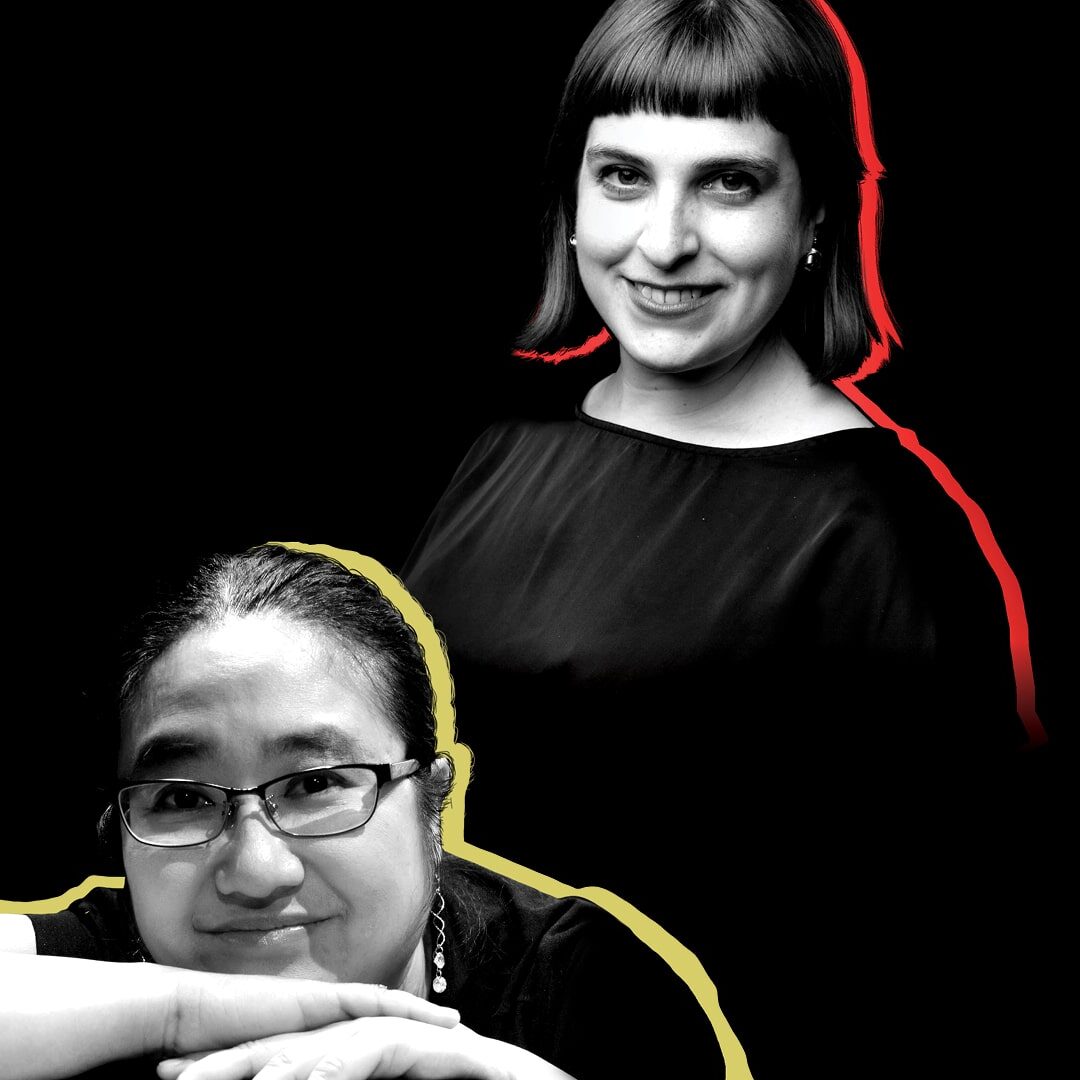
Canadians Juliane Gallant and Jennifer Tung are named the inaugural Conductors in the landmark national conducting fellowship Women in Musical Leadership.
Women in Musical Leadership is an innovative multi-year professional opportunity to advance music directors and conductors and richly expand the talent pool of musical leadership in Canada. The three-year program is for 6 participants in cohorts of 2, beginning a year apart.
The initiative, first announced in October 2020, is led and coordinated by Canada’s leading producer of contemporary opera Tapestry Opera, in partnership with Pacific Opera Victoria, Lead Orchestral Partner Toronto Symphony Orchestra, and in collaboration with leading opera and music organizations across Canada.
In a joint statement, Tapestry Opera’s Artistic and General Director Michael Mori and Executive Director Jaime Martino said:
“Jennifer and Juliane are two of the brightest talents that Canada has to offer, emerging at the top in a very competitive first year. They exemplify the talent, passion, and great potential of women and non-binary musicians in Canada, who through this program will be provided the opportunities to build a deep and well-rounded foundation as conductors and music directors. This fellowship is a celebration of Canadian companies from coast to coast coming together to train the next generation of musical leadership. We thank our partners and welcome Juliane and Jennifer to an exciting next three years.”
New Brunswick-born Juliane Gallant is a conductor, pianist, and coach, with degrees from the Université de Moncton, the University of Ottawa, and the Conservatoire de musique et d’art dramatique de Montréal. She is returning to Canada from the UK where she trained at the National Opera Studio and the Guildhall School of Music and Drama.
“I am absolutely thrilled to be taking part in Women in Musical Leadership. This fellowship has given me a huge gift, the opportunity to finally focus entirely on conducting over an extended period of time. I can’t wait to meet new opera companies, new orchestras, new scores, and new musicians as I continue to learn and grow as an artist. I am looking forward to every single part of this fellowship, and can’t wait to get started!” – Conductor Juliane Gallant
Etobicoke-based Jennifer Tung is the Artistic Director of Toronto City Opera, Mississauga Children’s Choir and Assistant Conductor of the Mississauga Symphony Orchestra. She was Assistant Conductor for Tapestry Opera and Opera on the Avalon’s Dora award-winning Shanawdithit by Dean Burry and Yvette Nolan, and is on faculty at the Glenn Gould School. She holds degrees in vocal performance and collaborative piano from the Eastman School of Music and studies conducting with Denis Mastromonaco.
“Looking at my musical journey so far, from concert pianist to vocalist to collaborative pianist/vocal coach, I have loved (and still love) every part of this journey but it is when I found conducting that I finally feel like I am home. I am so humbled and excited to be awarded this fellowship so I can focus on learning from the fantastic mentors as well as getting experiences on the podium that will help me hone this incredibly complex craft. I look forward to collaborating with many phenomenal musicians, to learn from them and to share my passion with them. Thank you for making it possible for me to realize my dream.” – Conductor Jennifer Tung
Gallant and Tung will be mentored by veteran conductors Rosemary Thomson (Okanagan Symphony and Opera Kelowna) and JoAnn Falletta (Buffalo Philharmonic), alongside ongoing support from accomplished conducting advisors including Pacific Opera Victoria’s Artistic Director Timothy Vernon and Toronto Symphony Orchestra’s Music Director Gustavo Gimeno.
Their fellowship begins at the end of January. Applications for the second cohort will reopen in late 2021.
Originally slated for a live production in April 2020, Rocking Horse Winner first became an experiment in rehearsing remotely, and then a gorgeous, lush cast recording from the Ernest Balmer Studio in July.
Music Director Kamna Gupta describes her experiences conducting through Zoom, and why she thinks there’s a lot to learn from doing things differently.
How was your experience rehearsing remotely, rather than in the studio?
The hardest thing was not getting to be in the room with the singers and with the musicians. My favourite thing about conducting has always been getting to make music in the moment.
However, what turned out to be great about doing the piece this way was that we focused entirely on the music and telling the story through the voice alone. There was no set, no costumes, and no staging, so we faced a very different challenge in the storytelling. It was all in the voice, and forced us to explore that dimension in a really deep way.
How did the rehearsals actually work?
The pianist and I made “karaoke” tracks of the whole show, and sent these recordings to the cast. They played them in their living room from a loudspeaker or their phones and sang one at a time. If one person was singing, their scene partner was muted and singing for their own practice and listening to what the unmuted singer was doing.
What promising ideas do you think will come out of this way of working?
I think we as an industry have to be really open to doing things differently. For example, for this show, we created a whole package of what we called “smart tracks”, which contained the piano accompaniment and a selection of voices. Each singer received a personalized package with all parts except their own, which was muted. This meant that the singers could prepare the entire show with other singers singing back to them!
What advice would you give to artists rehearsing remotely?
“Give yourself more time than you think you will need” would probably go at the top of the list! Be patient with the process.
Online rehearsing is a completely new concept, so there’s a lot that we’re still figuring out as individuals and as an industry. Like, whether Zoom is always the best software, what microphones work best, how to avoid internet issues, or how to deal with cats bursting into the frame!
The Rocking Horse Winner studio album is on sale now.
National conducting fellowship for women musicians
A coalition of Canadian companies led by Tapestry Opera and Pacific Opera Victoria, with lead orchestral partner, the Toronto Symphony Orchestra, are championing the next generation of conductors and addressing an historic gender imbalance in classical music
In the face of one of the worst professional gender imbalances in the country, Canada’s leading producer of contemporary opera Tapestry Operais launching an innovative multi-year opportunity titled Women in Musical Leadership, a full-time professional conducting fellowship to advance six talented women and non-binary music directors and conductors and richly expand the talent pool of musical leadership in Canada.
Tapestry Opera, known for innovative partnerships and next-generation practices, will lead and coordinate this paid three-year fellowship, in partnership with industry innovator Pacific Opera Victoriaand lead orchestral partner Toronto Symphony Orchestra, as well as numerous other opera and music organizations.
The program has been created to not only help collectively develop our next generation of musical leadership, but also to address the fact that there is only 1 female music director currently in the top 12 Canadian opera companies1, the number of women music directors or assistant conductors in the top 12 Canadian symphony orchestras who were born and trained in Canada is only 12 and in the 2018 / 2019 season only 6.2% of conductors in the largest six Canadian opera companies were women3.
Tapestry Opera Artistic and General Director Michael Hidetoshi Mori, frustrated by an immovable status quo, said:
“The most common reason that opera companies and professional orchestras cite for not hiring women is that there is a lack of qualified candidates. This program was designed to change that perception, partnering with multiple organizations across the country for a national impact. In my 30-year career in classical music, it has always been evident that our greatest talent is evenly split across gender lines – it remains on us to make opportunities for this talent to grow, mature and be seen and recognized in leadership roles.
The Women in Musical Leadership fellowship will deliver three years of practical conducting experience and training, while developing a professional network that spans Canada. I’m delighted to partner with our friends Pacific Opera Victoria and lead orchestral partner the Toronto Symphony Orchestra in launching this program which celebrates the artistic achievement of female artists.”
Starting remotely in February 2021, with placements from July 2021 through and lasting until June 2024, musicians looking to commit their careers to conducting will be engaged by Tapestry Opera, Pacific Opera Victoria and over a dozen participating organizations across Canada, including lead orchestral partner Toronto Symphony Orchestra whose new Music Director Gustavo Gimeno will provide ongoing mentorship.
In addition, each participant will partner for conducting and career mentorship with a senior female conductor, who will help guide them through their assigned three full years of conducting opportunities, with increasing responsibilities as the fellowship progresses.
Canadian conductor Rosemary Thomson (Okanagan Symphony and Opera Kelowna) will be joining the program as a Career Mentor:
“I remember asking a friend twenty five years ago if she thought that my university would consider taking a woman into the conducting program. Thankfully, times have changed since then, but seeing a woman on the podium is still rare enough to be considered anovelty. This fellowship will help to change that perception and show that conducting is not exclusively a male profession. I am thrilled to be involved in this transformative program that directly addresses the gender imbalance at the leadership level in classical music. I love everything about conducting and I can’t wait to share what I have learned with the next generation of conductors.”
JoAnn Falletta (Buffalo Philharmonic) will be joining Rosemary as a Career Mentor for the first year of participants.
The Women in Musical Leadership program is supported by the Azrieli Foundation.
1 – Judith Yan, Music Director and Resident Conductor at Opera on the Avalon
2 – Naomi Woo, Assistant Conductor at Winnipeg Symphony Orchestra, born and trained in Canada
3 – Judith Yan was the only female of 16 conductors. The largest 6 Canadian opera companies include Calgary Opera Association, Canadian Opera Company, Edmonton Opera, Opera de Montreal, Pacific Opera Victoria and Vancouver Opera
Safe, live performances available in neighbourhoods across Toronto throughout the summer and fall of 2020
Design by Rachel Forbes
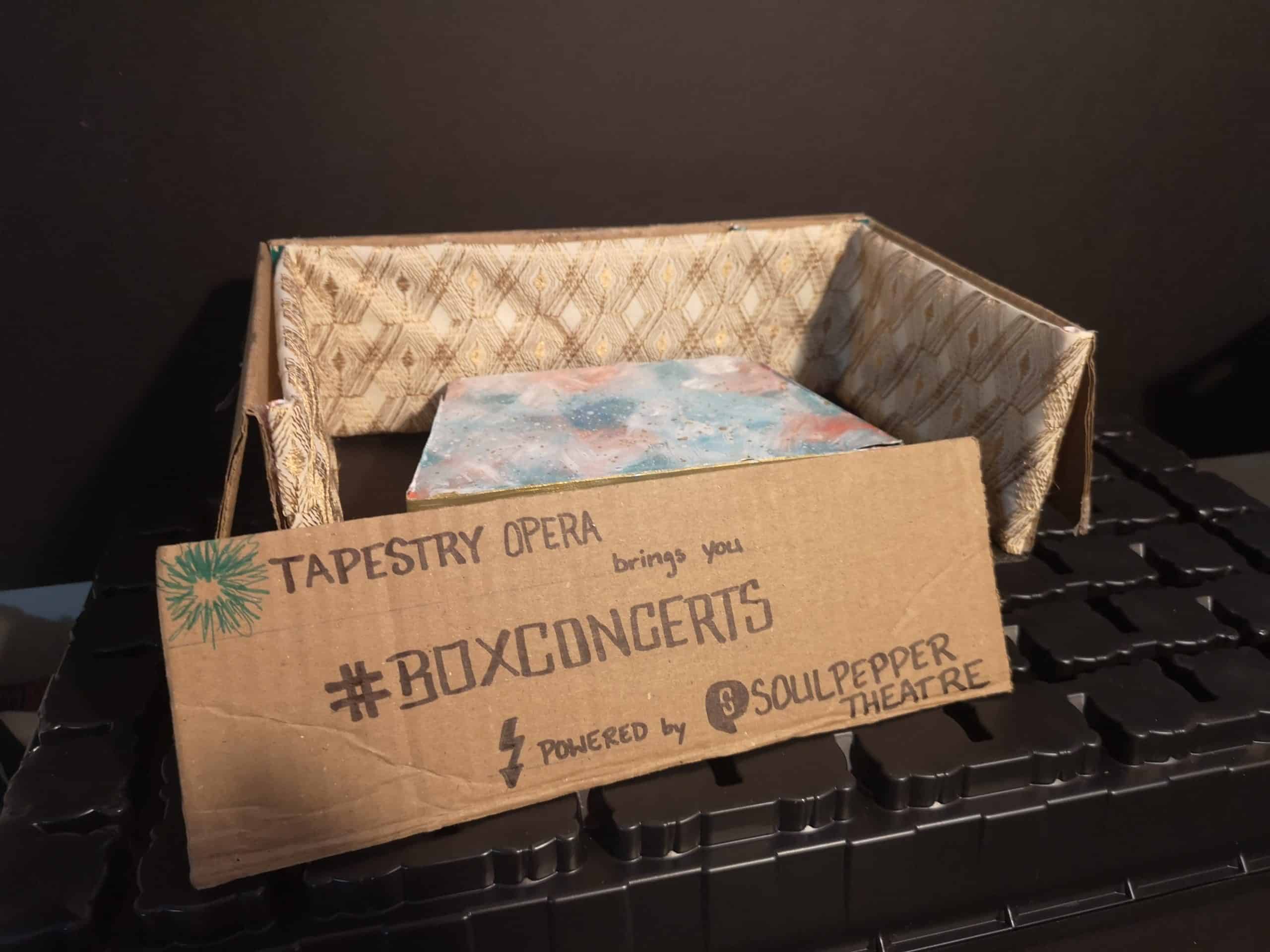
TORONTO – Tapestry Opera is driving live music to Toronto’s neighbourhoods this summer with an innovative curbside delivery program, Box Concerts (#BoxConcerts), a core initiative of Tapestry’s “Immune to Cancellation Season”.
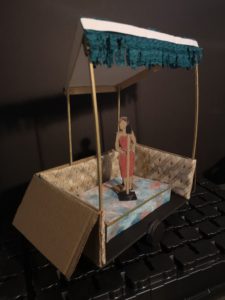
In collaboration, Distillery District neighbours Soulpepper Theatre Company and Tapestry Opera have built a compact travelling “box stage” to deliver singers and instrumentalists across the city. Box Concerts will offer free curbside concerts to community centres, care homes, and frontline workers, delivering world-class performers to communities hit hardest by the pandemic. Torontonians who are missing the thrill of live music and theatre can book a performance to enjoy from their own porches, or donate a performance to a worthy health facility or community area.
The pilot project offers two concerts: Classic Musical Theatre & Opera, and Classical Cello. Private performances can be booked for $150 per performance.
Artistic Directors Michael Hidetoshi Mori of Tapestry Opera and Weyni Mengesha of Soulpepper were enthusiastic about new possibilities for safe, outdoor live performance and for finding ways to reach communities and people in need of connection, music and inspiration.
“So many of us are stuck at home feeling isolated and screen-saturated. This innovative “boxed” stage goes a long way towards helping us feel connected and engaged. It’s also a creative way for Tapestry Opera and Soulpepper to keep artists employed during this time of massive cancellations.”
Michael Hidetoshi Mori, General and Artistic Director, Tapestry Opera
“It is more important than ever to find ways to safely bring humans together and to use theatre and music to help our communities and front line workers heal and recover.
We are happy to support our neighbours Tapestry Opera in building this stage and look forward to bringing music and joy to those in need of it.”
Location: Toronto, ON Type: Full-time, permanent Reports to: Executive Director Salary range: $50,000 to start
Tapestry Opera is seeking a talented, savvy communicator to join our team!
Tapestry Opera is an award-winning independent opera producer known for innovative and progressive practices in developing and producing opera, currently celebrating its 40th anniversary season. Our team consists of FIVE full-time staff and has recently restructured in order to open up a SIXTH position as the company expands. We value collaboration and rigour in developing and producing new works as much as we do collaboration in our administrative work. The company culture onstage and off is one that welcomes new ideas, strives to evolve, and cultivates new practices. As North America’s most prolific commissioner of new operatic work, we tap into vital and relevant stories and diverse musical traditions as part of our mandate. We are the leading opera company in Canada in performing works by women and artists from diverse backgrounds and believe strongly in progressively reflecting and engaging the world we live in through our works and throughout all of our organizational activities.
Recently, we have dealt with the COVID crisis by guaranteeing all artists fees, pivoting to livestreaming and remote collaboration, and launching a 2020-2021 season “Immune to Cancellation”.
The Marketing and Communications Manager will develop and execute the communications, marketing, and promotions of Tapestry Opera’s brand, seasons, and individual shows. We are looking for both a strategic thinker and a hands-on executor who is ready to complement the growth of the brand and become a leader in our innovative, dynamic organization. We’re a highly collaborative team, and this role would work closely with the General Director, Executive Director, Manager of External Relations, and the Manager of Patron Engagement to ensure consistency of tone and message across platforms.
We are committed to equity in hiring and specifically encourage people from communities of colour, LGBTQ2S, Indigenous, disabled, and other equity-seeking communities to apply
Things that matter:
We make art that is socially engaged – you have an understanding or lived experience of principles of equity and anti-oppression, and/or are interested in and open to the process of learning
You have relevant experience in Marketing & Communications (minimum 1-3 years professional experience preferred), with a track record of success.
You have exceptional writing and communication skills.
You are analytical and tuned in to new marketing trends.
You have proficiency with Google Suite, Microsoft Office, WordPress, and basic design skills (familiarity with one or more of the following preferred: InDesign, Publisher, Photoshop, Illustrator, etc.).
You have an interest in, and understanding of, the arts – knowledge of opera an asset.
You see challenge as an opportunity
You are looking for work you’ll love. We do this because we love the work, and we like each other.
What we Offer:
Comprehensive health benefits
Flexibility with hours, work-from-home days
Casual working environment
Unlimited vacation and paid time off
Open, transparent, and communicative office culture
Professional development opportunities
Office located in a bright, beautiful heritage building in the Distillery Historic District.
Your expertise is valued and trusted, and you will have real input into decision-making
Tickets to all Tapestry productions.
What you will do:
This is a comprehensive but not exhaustive list, in which there is room for growth in particular areas of interest to the applicant. As with any small organization, additional duties as required, within reason and subject to discussion.
Communications and Marketing:
Develop marketing and communications strategies for all events, productions, video releases
Ensure all communications further strategic goals, adhere to overall communications and branding plan, and represent Tapestry in tone and content
Ensure a unified image and approach to written communications is used for all Tapestry external correspondence: (newsletters, press releases, information packages, etc.), in collaboration with the Manager of External Relations, Executive Director, and Artistic Director.
Develop and oversee Communications Calendar, integrating social media, email, and direct mail appeals, in conjunction with the Patron Engagement Manager, Executive Director, and Artistic Director
Research target audiences and collaboratively develop imaging and key messages for Tapestry’s marketing materials.
Write/edit all marketing copy; work with Patron Engagement Manager to develop donor copy
Design and create season brochure, production one-pagers, poster copy, with support from the General Director and Executive Director.
Manage marketing collateral creation timelines, including video
Develop and execute social media strategy as part of overall Marketing Plan, including daily and weekly posts on all social media platforms (Facebook, Twitter, Instagram, LinkedIn, etc)
Promotion and Productions:
Optimize Tapestry’s SEO and promote YouTube, Instagram, Facebook, Twitter, and LinkedIn channels
Manage and track expenses for Tapestry’s annual Marketing budget.
Together with Tapestry staff, achieve budget targets for ticket sales and subscriptions
Identify advertising opportunities and facilitate listings and ad purchases.
Ensure that marketing materials are documented and/or archived as necessary.
Find cross promotional partnerships for Tapestry events and arrange for reciprocal marketing where possible (flyer & list exchanges, e-blasts, website presence, etc.).
Act as key contact for Tapestry’s contracted Public Relations firm.
Assist with coordination of media bookings, media kits and interview requests.
Write news releases either in collaboration with contracted Public Relations firms or on behalf of Tapestry (where outside of the PR firm contract) and assist or take the lead on media distribution and follow-up.
Be available for Tapestry shows, as required for press and donor/sponsor liaison.
Website:
Ensure website information is up-to-date and reflective of current organization and activities, including planning ahead for release of new materials and website support for all activities
Develop web analytics, maintain necessary codes and api keys to generate custom analytics and use Excel tools to create infographic enhanced reports on web analytics.
If this sounds like something that you could love, we’d like to hear from you.
Checklist: Please include as one complete pdf file, in this order:
Cover letter (hint, research the company) on why you’d like to work for Tapestry and why you think you’d make and excellent candidate for this role.
Up-to-date resume.
If you are invited for an interview, please bring two writing samples and two references that we can contact by phone and/or email. Emailjmartino@tapestryopera.com with your pdf attachment and include Marketing and Communications Manager in the subject line.